
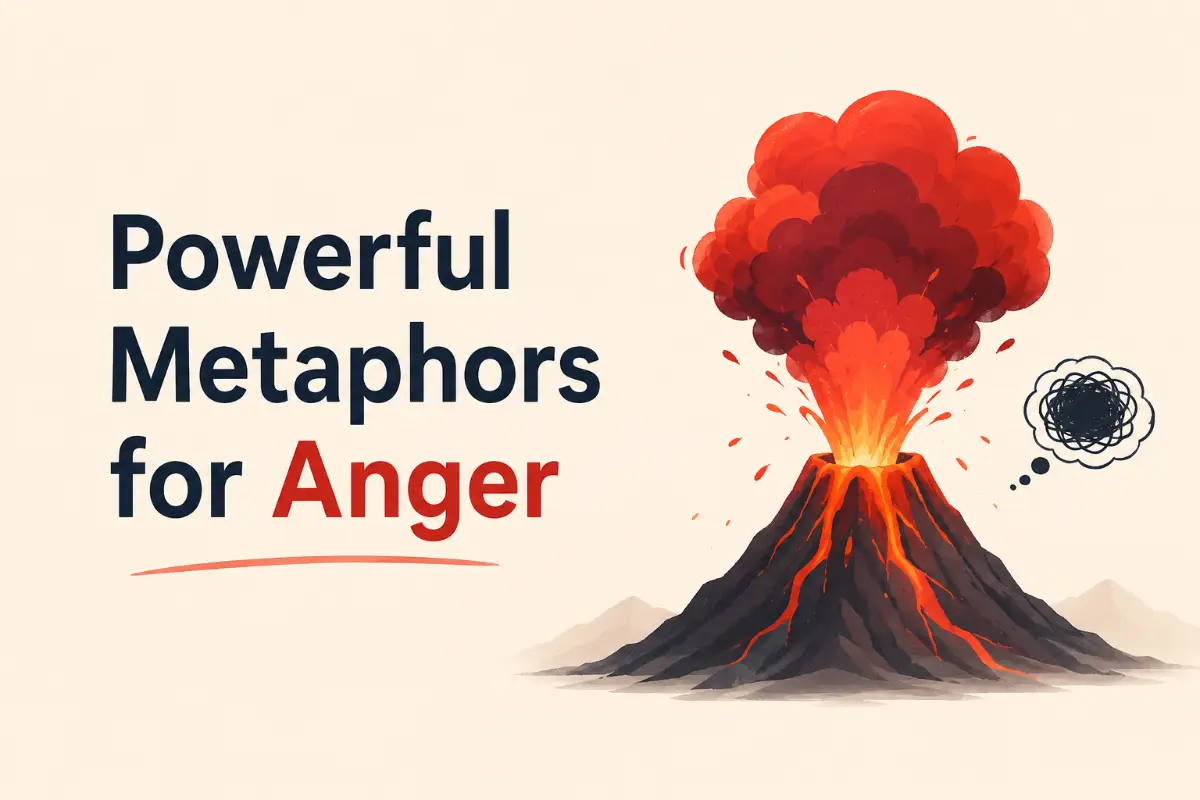
We have all felt anger so strong that saying “I am angry” doesn’t quite capture it. Sometimes frustration feels like fire in your chest, pressure behind a closed door, or a storm waiting to break. That is where metaphors for anger become useful.
A metaphor lets you describe an emotion through something people can see, feel, or imagine. Instead of simply telling readers that a character is furious, you can show that their anger is a volcano ready to erupt or a fire spreading through dry grass.
Quick Answer
A metaphor for anger is a figure of speech that describes anger by directly comparing it to something else, such as fire, a storm, an explosion, an animal, or a powerful force. For example, “His anger was a raging fire” presents anger as something hot, powerful, and difficult to control.
Anger metaphors can make everyday communication more vivid, strengthen creative writing, and help readers understand an emotion without explaining every detail.
In this guide, you’ll find more than 50 examples of anger metaphors, explanations of what they mean, comparisons with similes and idioms, literary examples, and practical tips for creating your own.
What Is a Metaphor for Anger?
A metaphor for anger is a form of figurative language that describes anger through another image or concept. Rather than explaining the emotion literally, the writer connects it to something more concrete.
For example:
His anger was a volcano.
The sentence doesn’t mean that the person has literally become a volcano. It suggests that his anger is powerful, building beneath the surface, and capable of erupting suddenly.
A metaphor works because readers already understand something about the source image. Most people know that fire can spread, pressure can build, storms can become destructive, and volcanoes can erupt without warning. Connecting those familiar ideas to anger gives the emotion a stronger shape.
In cognitive linguistics, this process is often described as connecting an abstract target domain with a more concrete source domain. Anger is abstract because you cannot hold it or see it directly. Fire, pressure, storms, and animals are easier to imagine.
That is why physical imagery appears so often when people talk about emotions.
Why We Rely on Physical Imagery
Feelings happen inside us, but language has to communicate them outside us.
When people become angry, they may feel hot, tense, restless, shaky, or physically charged. These sensations give us natural images for describing anger.
That is why English contains expressions connected with heat, pressure, movement, and destruction.
We say someone’s blood is boiling, their temper flares, or they explode with rage.
These expressions turn an invisible emotion into something readers can picture.
50+ Metaphors for Anger With Meanings
The best metaphor depends on the kind of anger you want to describe. A sudden outburst needs a different image from quiet resentment or controlled frustration.
Here are more than 50 examples you can use for creative writing, storytelling, speeches, essays, and everyday communication.
Heat and Fire Metaphors
Heat and fire are among the most familiar ways to describe anger. They work especially well when you want to show intensity, rising emotion, or destructive energy.
1. His anger was a raging fire.
This suggests powerful anger that is spreading and becoming difficult to control.
2. Her temper was a lit match.
This describes someone who can become angry very quickly.
3. His blood was boiling.
This means he was extremely angry about something.
4. She was burning with rage.
This suggests intense and consuming anger.
5. His temper was a wildfire.
This describes anger that spreads rapidly and affects everything around it.
6. Her resentment was a smoldering ember.
This suggests anger that remains hidden but has not disappeared.
7. Anger was burning inside him.
This presents anger as an internal fire.
8. His words were flames.
This suggests that his angry words were harsh, damaging, or emotionally painful.
9. Her fury was an inferno.
An inferno represents extremely intense and destructive anger.
10. His temper was a furnace.
This presents anger as a constant source of intense heat.
11. Her frustration was a spark in dry grass.
This suggests that even a small event could trigger a much larger reaction.
12. His rage was a firestorm.
This presents anger as both intense and chaotic.
Pressure and Explosion Metaphors
Pressure metaphors are useful when anger has been building for some time. They create a sense that something is about to happen.
13. He was a ticking time bomb.
This describes someone whose anger is building toward an explosive reaction.
14. Her patience was a pressure cooker.
This suggests that frustration is being contained until it becomes overwhelming.
15. His anger finally exploded.
The metaphor presents a sudden emotional outburst as an explosion.
16. She blew her fuse.
This describes losing control of your temper.
17. He reached his boiling point.
This means his patience had finally run out.
18. His frustration was building pressure.
This suggests that anger was increasing gradually.
19. Her temper was ready to burst.
This creates the image of emotion becoming too strong to contain.
20. He was a volcano waiting to erupt.
This suggests that intense anger was hidden beneath a calm surface.
21. Her patience was stretched to the breaking point.
This describes a situation where continued pressure may cause an emotional reaction.
22. His anger burst through the walls of his restraint.
This presents self control as a physical barrier that anger eventually breaks.
23. The argument was a pressure chamber.
This suggests an environment where tension keeps increasing.
24. His frustration was an overloaded circuit.
This compares emotional overload with a system that can no longer handle additional pressure.
Animal and Monster Metaphors
Animal imagery can make anger feel instinctive, aggressive, or difficult to control.
25. The beast inside him awakened.
This suggests that intense anger brought out a more aggressive side of his personality.
26. Rage was a wild animal inside her.
This presents anger as something powerful that struggles against control.
27. His temper had claws.
This suggests that his anger could hurt others.
28. Anger was a hungry beast.
This presents anger as something that grows stronger when it is fed.
29. The monster of resentment lived inside him.
This suggests long lasting anger that has become part of someone’s emotional life.
30. She unleashed the beast.
This means she stopped controlling her anger and allowed it to come out.
31. His fury was a charging bull.
This creates an image of sudden, forceful aggression.
32. Her anger stalked the room like a predator.
This suggests a tense atmosphere in which anger feels constantly present.
33. His temper had teeth.
This presents his anger as threatening and capable of causing harm.
Weather and Nature Metaphors
Nature metaphors work well because storms, hurricanes, and earthquakes are powerful forces that people cannot easily control.
34. A storm was brewing inside him.
This suggests that anger was developing beneath the surface.
35. Her anger was a thundercloud.
This creates an image of dark and threatening emotion.
36. His face was a storm.
This suggests that his expression clearly showed his anger.
37. Her temper was a hurricane.
This presents anger as chaotic, powerful, and destructive.
38. His rage was an earthquake.
This suggests anger powerful enough to shake everything around him.
39. Their argument was a thunderstorm.
This presents a conflict as loud, intense, and emotionally charged.
40. Her resentment was a dark cloud.
This suggests an unpleasant emotion that remains present over time.
41. His fury was a tidal wave.
This describes anger that arrives with overwhelming force.
42. Anger swept through him like a flood.
This presents an emotion that suddenly becomes difficult to resist.
Weapons and Destructive Force Metaphors
These metaphors are especially effective in dramatic writing because they emphasize emotional damage and intensity.
43. Her words were arrows.
This suggests that her angry words were designed to hurt.
44. His anger was a loaded weapon.
This presents anger as something dangerous that could cause damage.
45. Her resentment was poison.
This suggests that holding onto anger is gradually harmful.
46. His words were daggers.
This presents harsh speech as emotionally painful.
47. Anger was a wrecking ball inside him.
This suggests an emotion capable of destroying his peace or relationships.
48. His fury was a hammer.
This presents anger as forceful and relentless.
49. Her frustration was a sharp blade.
This suggests that her frustration felt painful and cutting.
Cold and Darkness Metaphors
Not every kind of anger is loud. Some anger becomes quiet, distant, and emotionally cold.
50. His anger was a block of ice.
This suggests controlled anger that has become emotionally distant.
51. Her resentment was a frozen wound.
This presents old anger that has never fully healed.
52. His silence was a dark room.
This suggests anger that remains hidden instead of being openly expressed.
53. Her fury was a shadow following him.
This suggests that unresolved anger continues to affect someone.
54. His resentment was winter in his heart.
This presents long lasting anger as emotional coldness.
55. Her anger was a locked door.
This suggests that anger has created emotional distance.
Metaphor vs. Simile vs. Idiom for Anger
These three forms of figurative language can look similar, but they work differently.
| Figure of Speech | Definition | Anger Example |
|---|---|---|
| Metaphor | Directly compares one thing with another | His anger was a volcano. |
| Simile | Uses words such as like or as to make a comparison | He shook like a leaf with rage. |
| Idiom | A culturally established expression with a figurative meaning | She flew off the handle. |
A simple test can help.
If you say “His anger was a volcano,” you are using a metaphor.
If you say “His anger was like a volcano,” you are using a simile.
If you say “He flew off the handle,” you are using an idiom.
The distinction matters in grammar and literary analysis because each device creates a slightly different effect.
Literary Examples of Anger Metaphors
Writers have long used figurative language to make anger visible to readers.
Classic Literature
Shakespeare frequently connected human emotions with powerful natural forces. In King Lear, emotional conflict becomes connected with storms, violence, disorder, and overwhelming natural imagery.
This approach makes a character’s anger feel larger than an ordinary disagreement. The external world seems to reflect the emotional chaos happening inside the character.
That technique is useful for writers today, too.
Instead of writing:
John was extremely angry.
A writer could say:
John carried a storm behind his eyes.
The second sentence gives the reader an image. The reader can imagine darkness, tension, and the possibility of an approaching outburst.
Modern Writing
Modern writers often combine metaphors with sensory details.
For example:
Battery acid crawled through his veins.
This metaphor presents anger as corrosive and physically uncomfortable.
Another example is:
Her patience was a frayed rope.
The rope represents emotional endurance. As it becomes more damaged, the possibility of snapping becomes greater.
Strong metaphors don’t need to be complicated. A familiar image can become powerful when it fits the character and situation.
How to Write Your Own Metaphors for Anger
Creating original metaphors becomes easier when you stop searching for a clever phrase and start thinking about the exact feeling you want to communicate.
Identify the Type of Anger
First, decide what kind of anger your character or speaker feels.
Is it a brief flash of irritation?
Is it deep resentment?
Is it controlled frustration?
Is it explosive rage?
Is it quiet anger that has lasted for years?
Each emotion suggests different imagery.
A flash of irritation might be a spark.
Long resentment might be rust.
Explosive rage might be a volcano.
Choose a Source Image
Next, think about physical objects, animals, places, or natural forces that behave like the emotion.
For example:
Pressure
A pressure cooker.
A sealed container.
A balloon.
A compressed spring.
Destruction
A wrecking ball.
An earthquake.
A wildfire.
A hurricane.
Quiet resentment
Rust.
Ice.
A buried ember.
A crack in glass.
Connect the Image to the Emotion
Now combine the emotional idea with the physical image.
Instead of:
She was angry.
Try:
Her patience was a frayed wire.
Or:
His resentment was rust spreading beneath fresh paint.
The metaphor works because the image tells the reader something about the emotion.
Make the Metaphor Specific
Specificity often makes an ordinary metaphor more memorable.
Compare these two sentences:
His anger was fire.
His anger was a candle flame trapped beneath a glass jar.
The second image gives the reader more information. It suggests anger that is contained but still burning.
Avoid Mixing Too Many Metaphors
A common writing problem is switching between unrelated images.
For example:
His anger was a volcano, a sharp sword, a storm, and a wild animal.
Each comparison could work independently, but using all of them at once can make the sentence feel crowded.
Choose one strong image and develop it.
His anger was a volcano beneath a quiet mountain.
That single metaphor creates a clearer picture.
The Psychological Impact of Figurative Language
Metaphors don’t just decorate writing. They can influence how people understand abstract experiences.
Anger is difficult to see directly, so physical imagery gives it boundaries and movement. Calling anger a storm emphasizes unpredictability. Calling it a fire emphasizes heat and intensity. Calling it a cage emphasizes restriction.
The image you choose changes the emotional interpretation.
For example, describing anger as a wild beast can suggest that the emotion is difficult to control. Describing it as a locked furnace suggests that the person is actively containing it.
This is particularly useful in storytelling because a metaphor can reveal a character’s relationship with anger without explaining it directly.
A strong metaphor can therefore communicate emotion, personality, conflict, and atmosphere in just a few words.
Common Mistakes When Using Anger Metaphors
Metaphors become less effective when they feel forced or overly familiar.
One common mistake is relying too heavily on clichés. Expressions such as “seeing red” and “boiling with rage” are understandable, but they may not feel fresh in creative writing.
Another problem is choosing an image that doesn’t match the emotion.
If a character is quietly resentful, describing their anger as an exploding bomb may exaggerate the situation. A metaphor involving rust, ice, or a buried ember may work better.
It’s also important to keep the surrounding context in mind. A metaphor should help readers understand the scene instead of making them stop to figure out what the writer means.
How to Describe Different Levels of Anger
The intensity of the metaphor should match the intensity of the emotion.
For mild irritation, you might write:
A small spark of annoyance flickered inside her.
For growing frustration:
His patience was a rope slowly fraying.
For serious anger:
A storm gathered behind his eyes.
For extreme rage:
His fury was a volcano breaking through its restraints.
For long lasting resentment:
Her anger was rust quietly eating through the relationship.
This approach helps you avoid using the same metaphor for every emotional situation.
Frequently Asked Questions
What Is the Most Common Metaphor for Anger?
Heat and fire are among the most common metaphorical images associated with anger. Expressions such as boiling blood, burning with rage, and a fiery temper connect emotional intensity with physical heat.
Is Seeing Red a Metaphor or an Idiom?
Seeing red is generally classified as an idiom because it is an established expression whose meaning is understood figuratively. It means becoming extremely angry.
What Is a Good Metaphor for Hidden Resentment?
Good metaphors for hidden resentment include smoldering embers, rust beneath the surface, a buried fire, and a frozen wound. These images suggest that the anger remains present even though it isn’t openly expressed.
What Is a Metaphor for Extreme Anger?
For extreme anger, powerful images such as an erupting volcano, a raging wildfire, a hurricane, or an exploding pressure cooker can communicate intensity and loss of control.
What Is a Metaphor for Quiet Anger?
Quiet anger can be compared to ice, a buried ember, rust, a locked door, or a dark cloud. These metaphors suggest emotion that exists beneath a controlled exterior.
How Do You Describe Anger Creatively?
Start by identifying the exact type of anger. Then choose a physical image that behaves similarly. For example, quiet resentment could become rust eating through steel, while sudden fury could become a match dropped into gasoline.
What Is a Metaphor for a Short Temper?
A short temper can be compared to a lit match, dry grass waiting for a spark, or a hair trigger. Each image suggests that very little is needed to trigger an angry reaction.
Can Metaphors Make Writing More Emotional?
Yes. A strong metaphor gives an abstract emotion a concrete image. Instead of simply telling readers that someone is angry, you can show the emotion through heat, pressure, darkness, weather, or movement.
Conclusion
A good metaphor for anger does more than replace the words “I am angry.” It gives the emotion shape, movement, intensity, and personality.
Fire can show passion and destructive rage. Pressure can represent frustration that has been building. Storms can communicate chaos. Ice can reveal emotional distance. Rust can capture resentment that has quietly remained for years.
The key is to choose an image that matches the exact emotion you want your reader to feel.
So the next time “he was angry” feels too simple, look beyond the emotion itself. Ask what that anger feels like, what it does, and what physical force behaves in the same way.
That is where your strongest metaphor may be hiding.